

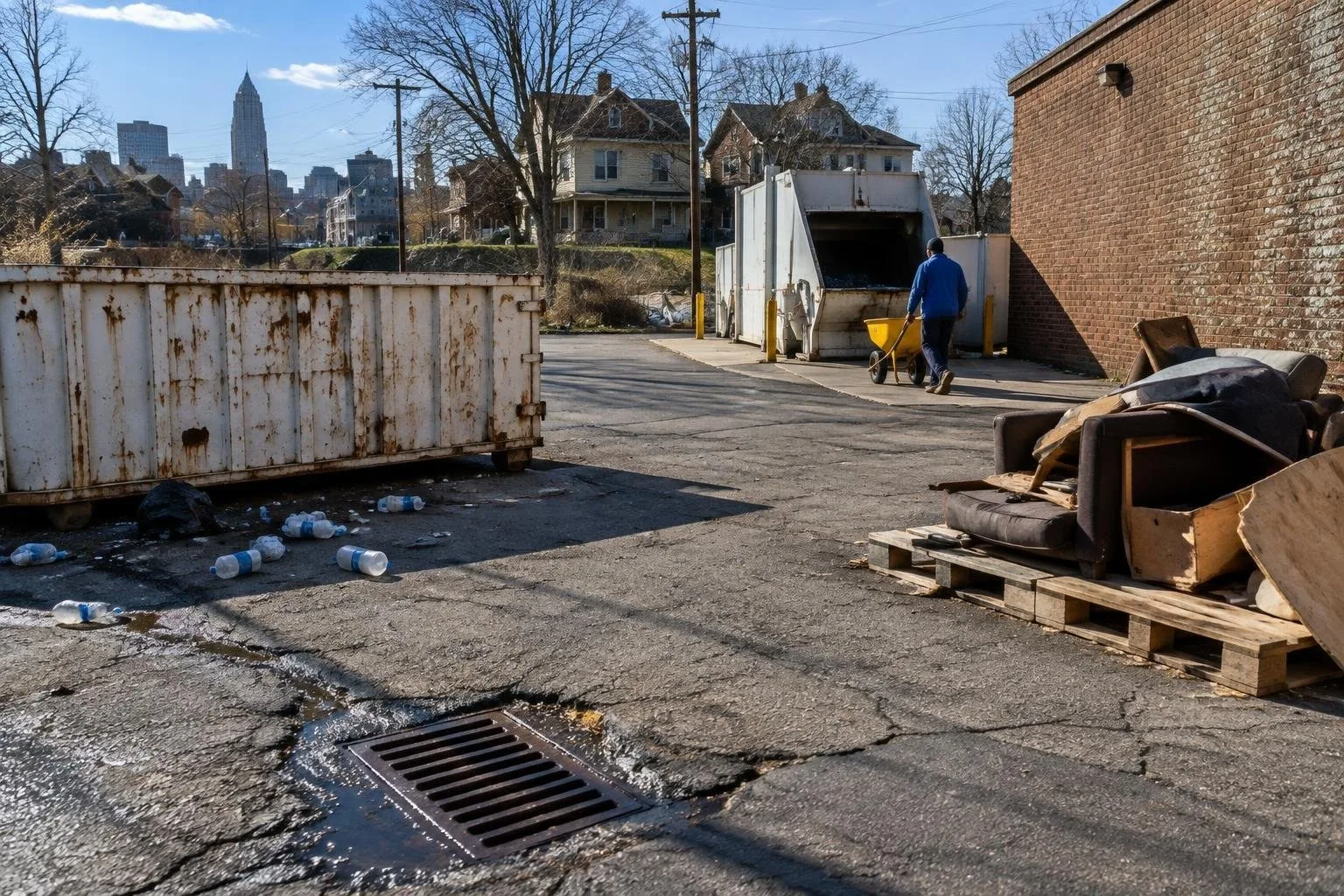
The city of East Cleveland has taken a decisive step against the long-standing problem of illegal debris dumping. Last week, Christopher Poklar, a resident of Conneaut, entered a guilty plea to a felony count of attempted open dumping. The court responded with a two-year probation sentence and a hands-on remediation order that will see Poklar directly involved in removing the material he tried to discard, as well as cleaning up additional sites throughout the municipality.
According to the police report, the incident originated in August when a passerby observed a dump truck unloading concrete and assorted waste onto a vacant lot along Hayden Avenue. Surveillance footage captured the truck arriving loaded, turning around, and departing empty moments later. When officers confronted Poklar, he denied any involvement, insisting he had never been at the location. The investigation, however, confirmed that illicit dumping in East Cleveland is classified as a felony offense, a fact that carried significant weight during sentencing.
The court’s decree and community service mandate
Judge-imposed conditions require Poklar to spend eight days performing cleanup duties at various illegal dump sites around East Cleveland. In addition to this community service, he must personally restore the concrete and debris he attempted to discard on Hayden Avenue. The dual approach—probation coupled with direct remediation—reflects the city’s broader strategy to make offenders shoulder the cost of their actions while deterring future violations.
Legal authorities emphasized that the punishment serves both punitive and restorative purposes. Ken Myers, East Cleveland’s Law Director, stated, “Our message to anybody that wants to offload their debris or junk in our city is we are going to catch you and if we catch you, you’re going to pay the price.” This assertive tone underscores the municipal government’s resolve to protect neighborhood aesthetics and public health.
Resident reaction and the city’s anti-dumping campaign
Local resident Donquell Howard, who lives near the affected field, expressed relief that the case concluded with tangible consequences. “I wish it would stop because it makes our neighborhood look bad, stuff like that. People don’t want to come here and invest money into the community because of that problem,” Howard explained. He added, “Lesson learned. I bet he won’t do it anymore,” signaling hope that the sentence will serve as a deterrent for other potential violators.
The crackdown is not an isolated effort. East Cleveland announced a comprehensive anti-dumping initiative last June, aiming to tighten enforcement and increase public awareness. Since that announcement, officials claim to have pursued roughly half a dozen additional illegal-dumping cases that are now moving through the court system. The city hopes that each successful prosecution, like Poklar’s, will incrementally improve the overall environment.
Looking ahead: enforcement and community impact
By mandating that offenders engage directly in cleanup, East Cleveland is attempting to transform punitive measures into community benefits. The eight-day service requirement is expected to remove a noticeable amount of waste from vulnerable areas, while the publicized sentence reinforces the legal ramifications of illegal dumping. City officials argue that such visible enforcement will encourage residents and businesses to adhere to proper disposal protocols.
As the legal process continues for the remaining pending cases, East Cleveland officials remain vigilant. The combination of strict legal classification, active surveillance, and community-focused penalties illustrates a multi-layered approach designed to curtail the practice that has plagued the city for years. If the strategy proves effective, other municipalities facing similar challenges may look to East Cleveland’s model as a blueprint for their own anti-dumping campaigns.